
Millions of students appear for competitive examinations every year across the world in a hope to secure good rank and along with that a seat in a reputed institution.
Although Worldwide many exams are difficult, only a few are so demanding . These exams test everything about a candidate like how strong they are mentally, are they able to handle and contain the stress levels , how disciplined they are and most importantly whether they can stay consistent over a long period without any deviation.
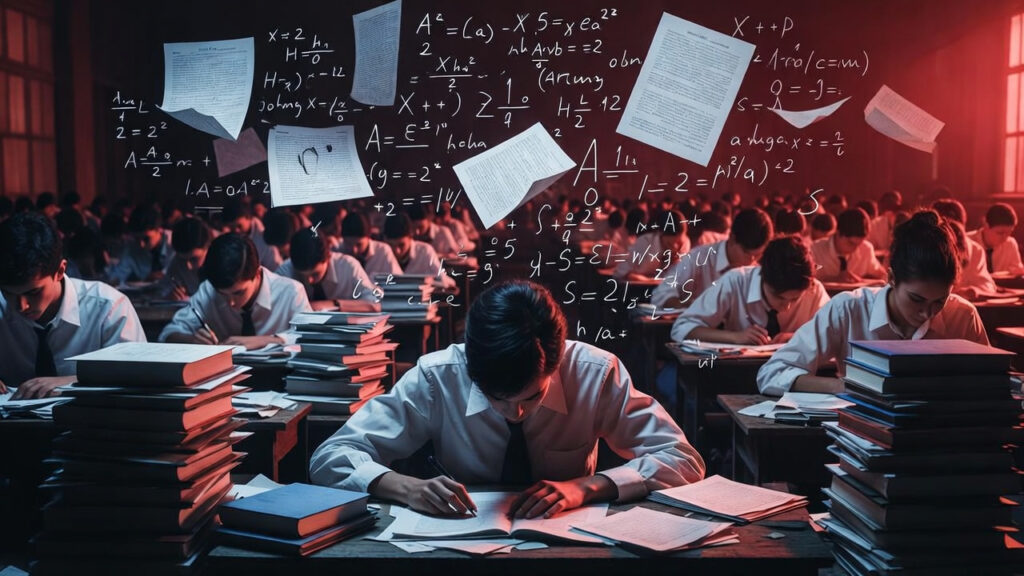
Rather than the academic they also look into the qualities specified above and hence the Exam seems extreme difficulty. These exams are considered the toughest in the world.
These exams are extremely hard not only because the syllabus is very large but also due the huge competition candidates have to face. Millions of aspirants look for a seat in reputed institution and to be frank the seats are very limited.
Only less than 1% candidates succeed in clearing such examinations. Aspirants usually spend many years for preparing and they give up personal comfort, free time, and sometimes financial security for just one chance to clear the exam. After all that sacrifice only 1% clears the exam.
For cracking these type of exams intelligence alone is not enough. Aspirants should not deviate from their goals and have to put strong focus, continuous effort day in day out.
So it is recommended to have strategic planning and most important thing is executing it with calm, even under extreme pressure situations.
Some of the world’s toughest exams include China’s Gaokao, the USMLE in the United States, the CFA exam for finance professionals and UPSC civil services in India.
To clear these exams having a clear and very deep understanding of concepts is crucial. Without knowing the concepts completely it is not possible to analyze and solve complex problems. For all this to happen students must have the endurance to study consistently for long hours over many months or even years. If they lack this skill they may fee overwhelming over a period of time.
In this article, we have put together a list of the world’s toughest exams, demonstrating why each one is so difficult. Apart from this we will also look into the aspects like how much effort and dedication these exams need. We will share practical ways on how students must be ready to handle both the study pressure and mental stress while preparing the exam.
Whether you are preparing for an exam or thinking about future career options, this ultimate guide will help you understand what it really takes to clear the hardest exams in the world.
Most Difficult Exams to Clear in 2026 World Wide
more than just a test. Once they clear the exam, its going to be turning point in their life. So every student, every family, Every School and even the government treat it with great seriousness.
In China and South Korea, a student’s future often comes down to just one exam—or a few intense days of testing. These aren’t ordinary school exams. They’re national events that practically bring the country to a pause. Families, schools, and even governments revolve around them, because the results can decide what kind of life a student will have.
Gaokao ( China )
Gaokao is China’s most important and hardest exam and it stands top the list of most difficult exams in the world. This entrance exam decides which university a student can study in. So students in China takes this exam very serious , as this can change their future career, and social position. The exam is held only once a year, and millions of students participate in it .
Students are tested in core subjects like Chinese, Mathematics, English, and some optional subjects.
The exam lasts for several days and creates very high pressure on students . In many cases, just one mark can determine whether a student gets admission into a top university. For students in China, Gaokao is
In China, this life-defining test is called the Gaokao, the National College Entrance Examination. It’s often described as the toughest undergraduate entrance exam in the world—and not without reason. The pressure doesn’t just come from how hard the questions are, but from what’s at stake. In China, the university you get into can shape your career, your income, and even your social status for years to come.
Every year, millions of high school students sit for this exhausting, multi-day exam. They’re tested in core subjects like Chinese, Mathematics, and English, along with either science or humanities subjects depending on their track. For many students, these few days represent the peak of more than a decade of nonstop preparation.
The scale of the Gaokao is almost hard to imagine. In 2024 alone, about 13.42 million students took the exam, all competing for a limited number of seats at top universities like Tsinghua University and Peking University. The odds are brutal: only a tiny fraction make it into these elite institutions—sometimes as low as 0.003% to 0.004%. In this environment, even a difference of a single point can decide whether a student enters a prestigious national university or ends up at a much less recognized local college.
For millions of students, the Gaokao isn’t just an exam. It’s a turning point that can change the direction of their entire life.
| Gaokao Examination Metric | Statistical Detail |
|---|---|
| Annual Candidates (2024) | 13,420,000 |
| Top University Seats | 50,000 – 60,000 |
| Admission Rate (Top Universities) | 0.003% – 0.004% |
| Exam Duration | 9 hours over 2–3 days |
| Core Scoring System | Typically out of 750 points |
| Required Score for Elite Universities | Above 600 points |
What makes the Gaokao even more intense is that it’s basically a one-shot deal. Unlike in many Western countries, where students can take exams like the SAT or ACT multiple times and improve their scores, the Gaokao usually happens just once a year, in June. That means years of brutal schedules—often studying 10 to 12 hours a day—come down to just two or three days of testing.
The pressure isn’t only on the students. The whole country seems to feel it. In many cities, construction work is paused, traffic is redirected, and noise rules are tightened around exam centers so students can test in silence. It’s that serious.
For many families, especially in rural areas, doing well in the Gaokao is seen as the only real path to a better life. That belief puts an enormous emotional and mental weight on young students’ shoulders—because for them, this exam doesn’t just decide a college. It feels like it decides their future.
The South Korean Suneung: More Than Just an Exam
Much like China’s Gaokao, South Korea’s Suneung officially called the College Scholastic Ability Test (CSAT) sits at the very center of the country’s academic pressure cooker. In the 2026 exam cycle, the number of test-takers climbed to 554,174, the highest in seven years. A big reason for this jump was demographic: students born in 2007, a so-called “Golden Pig” year known for higher birth rates, had now reached college age.
The Suneung itself is an exhausting, all-day test—about eight hours long, held on a single, carefully controlled day. Students are tested in Korean, Mathematics, English, Korean History, and a set of elective subjects. The rules around the day are famously strict. Test-takers must be inside their exam rooms by 8:10 a.m., and during the English listening section, flights across the country are temporarily grounded to keep noise to a minimum. That’s how seriously the country treats this exam.
| Suneung (CSAT) Schedule | Subject Area | Duration |
|---|---|---|
| Period 1 | Korean Language | 80 minutes |
| Period 2 | Mathematics | 100 minutes |
| Period 3 | English Language | 70 minutes |
| Period 4 | Korean History & Subordinate Subjects | 102 minutes |
| Total Active Testing | — | ~8 Hours |
In recent years, another interesting trend has taken hold, often called the “social studies rush.” After many universities changed their admissions rules and stopped requiring two science subjects for STEM majors, a large number of science-track students began choosing social studies instead, hoping for more predictable and stable scores. By the 2026 cycle, 77.3% of students picked at least one social studies subject—the highest level ever recorded.
All of this shows how strategic the Suneung has become. Students aren’t just studying hard; they’re carefully choosing subjects and planning every move to improve their chances of getting into South Korea’s most prestigious “SKY” universities—Seoul National, Korea University, and Yonsei—where acceptance rates for top programs still hover around just 2% to 4%. For many students, those numbers make every choice feel like it could change their future.
The Indian Exam Battlefield: Government and Engineering Gatekeepers
In India, competitive exams are on a whole different scale. The numbers are massive, the pressure is intense, and the rewards—especially government jobs and top technical seats—carry huge social prestige. Two exams in particular stand out for their difficulty and reputation: the UPSC Civil Services Exam and the JEE Advanced. Both are known not just for their tough syllabi, but for how few people actually make it through.
The UPSC Civil Services Exam: Like Studying an Entire Library
The UPSC Civil Services Examination (CSE) is the gateway to some of India’s most powerful and respected roles, including the IAS, IFS, and IPS. It’s not just an exam—it’s a year-long grind that tests patience, discipline, and mental stamina. The odds are brutal: only about 0.1% to 0.2% of candidates succeed.
In the 2024–2025 cycle, more than one million people applied for the first stage. In the end, only 1,009 candidates were selected. For most aspirants, that means years of preparation for a chance that’s slimmer than most people can imagine.
The UPSC exam is spread across three tough stages:
Preliminary Examination:
Two objective papers—General Studies and CSAT—adding up to about 4 hours of testing. This stage works like a giant filter, cutting the crowd down to a much smaller group.
Main Examination:
This is where things get really serious. Candidates write nine descriptive papers over several days, with a total of about 27 hours of exams. The syllabus is huge, covering history, polity, economics, ethics, and current affairs, among other subjects.
Personality Test (Interview):
The final step is a high-pressure interview that looks beyond book knowledge. Here, candidates are judged on their personality, clarity of thought, decision-making, and how they handle real-life situations.
For many aspirants, the UPSC isn’t just an exam—it becomes a way of life for years, demanding total commitment and mental toughness.
| UPSC CSE Statistics | 2024–2025 Data |
|---|---|
| Total Applicants | 1,000,000+ |
| Selected Candidates | 1,009 |
| Success Rate | ~0.17% |
| Total Testing Duration | ~31 Hours |
| Preparation Time | 2–3 Years |
The sheer size of the UPSC syllabus is enough to overwhelm anyone. Candidates are expected to know a little bit about almost everything—history, politics, economics, ethics, current affairs, and more—almost like carrying a mini library in their head. What makes it even tougher is this: if you fail at any stage, you don’t just pick up where you left off. You have to start the entire process all over again the next year. That “back to zero” reality adds a huge mental burden and makes the exam as much a test of endurance as of knowledge.
JEE Advanced: The Road to the IITs
The JEE Advanced is the final gatekeeper for getting into India’s prestigious IITs. Unlike exams that test many subjects at a surface level, JEE Advanced goes deep into just three: Physics, Chemistry, and Mathematics. The questions are famous (and feared) for being closer to Olympiad-level problems—they don’t reward rote learning. Instead, they demand strong concepts and the ability to think clearly under intense time pressure, often on problems students have never seen before.
Not everyone even gets a shot at this exam. Only those who clear JEE Main—usually the top 250,000 students—are allowed to appear for JEE Advanced. In 2024, around 180,000 candidates took the exam, and about 48,248 of them qualified. But qualifying doesn’t mean getting into a top IIT. When you look at the entire pool of original applicants, the real acceptance rate for the most sought-after IITs is still around 1%. For most students, that makes JEE Advanced one of the toughest academic hurdles they’ll ever face.
| JEE Advanced Metrics | Statistical Detail |
|---|---|
| Level | Undergraduate Engineering |
| Duration | Two papers, 3 hours each (6 hours total) |
| Subjects | Physics, Chemistry, Mathematics |
| IIT Acceptance Rate | ~1% |
| Candidate Volume (Advanced) | ~180,000 |
Why JEE Advanced Feels Even Tougher Than It Looks ?
What makes JEE Advanced especially brutal is how unpredictable it is. Unlike many exams where students can spot patterns and prepare accordingly, the paper format, question types, and even the marking scheme change almost every year. That means you can’t survive on memorization or shortcuts. You actually have to understand Physics, Chemistry, and Math at a deep level. For most students, reaching that level takes years of focused study and coaching, not just a few months of revision.
GATE: The Gateway to M.Tech and PSU Jobs
The GATE (Graduate Aptitude Test in Engineering) is another major filter in India, used both for postgraduate admissions and for hiring in top public sector companies (PSUs). In 2025, nearly 9.36 lakh candidates registered, and about 7.47 lakh actually showed up to take the computer-based exam.
| GATE Exam Statistics | 2024 | 2025 |
|---|---|---|
| Registered | 826,239 | 936,019 |
| Appeared | 653,292 | 747,319 |
| Qualified | 129,268 | 141,802 |
| Qualification Rate | 19.78% | 18.97% |
Among all the subjects, Computer Science is the most popular. In 2025 alone, around 1.7 lakh students appeared for the CS paper—about 23% of all candidates. What makes GATE tough isn’t just the syllabus, but the level of accuracy it demands. When it comes to top IITs, the competition is fierce: roughly 10 qualified candidates compete for every single M.Tech seat. One small mistake can push you far down the ranking.
Elite Global Professional Certifications
Some exams don’t just decide college admissions—they decide who gets to enter an entire profession. These certifications are known for their high standards, long preparation time, and low overall success rates.
CFA: The Everest of Finance
The Chartered Financial Analyst (CFA) program is considered the gold standard in the world of finance and investment management. It has three levels, and each one typically demands 300 hours or more of study. While the pass rate for any single level usually sits somewhere between 35% and 50%, the real challenge is clearing all three. In reality, only about 15% to 20% of those who start the journey ever finish it.
The CFA is tough because of both how much you have to study and how strict it is about ethics. The syllabus covers everything from derivatives and fixed income to accounting, portfolio management, and alternative investments. Most candidates take four years or more to complete all three levels.
CCIE: The Peak of Networking Certifications
In the IT world, the CCIE (Cisco Certified Internetwork Expert) is often seen as the ultimate badge of honor. It’s been around since 1993, and even today, fewer than 70,000 people have ever earned it. Only about 45,000 to 48,000 are currently active worldwide—which tells you how rare it is.
The CCIE has two brutal stages:
Written Exam: A 120-minute test that checks deep theoretical knowledge.
Lab Exam: An 8-hour, hands-on marathon where candidates must design, set up, fix, and troubleshoot complex network systems in real time.
| CCIE Global Distribution (2025 Estimates) | Percentage of Active CCIEs |
|---|---|
| North America | ~40% |
| Asia Pacific | ~30% |
| Europe | ~20% |
| Latin America | ~10% |
Passing CCIE isn’t just about knowing the theory—it’s about proving you can perform under pressure at an expert level. For many network engineers, it’s the hardest exam of their entire career.
The CCIE lab exam is split into two brutal parts: a 3-hour Design module and a 5-hour Deploy, Operate, and Optimize (DOO) module. Together, they test not just what you know, but whether you can actually build and fix complex networks under pressure. There’s even some legend baked into the certification’s history—the very first CCIE number, #1025, was awarded to Stuart Biggs, while the numbers before that were never used, adding to the mystique around the program. As for passing? On the first attempt, only about 10% to 20% of candidates make it through.
ICAI Chartered Accountancy (CA) Final Exam
In India, the CA Final is widely seen as one of the toughest professional exams you can take. To pass, students must score at least 40% in each paper and 50% overall in each group of subjects. Even then, the odds are harsh—especially for those who attempt both groups at the same time, where pass rates often drop below 10%.
| ICAI CA Final Pass Rate Trends | Both Groups | Group I | Group II |
|---|---|---|---|
| September 2025 | 16.23% | 24.66% | 25.26% |
| May 2025 | 18.75% | 22.38% | 26.43% |
| November 2024 | 13.44% | — | — |
| May 2024 | 19.88% | 27.35% | 36.35% |
| November 2023 | 9.42% | 9.46% | 21.60% |
What really sets the CA journey apart is the mandatory three-year articleship. During this time, students work in real offices, dealing with audits, taxes, and accounts while also preparing for their exams. This mix of full-time professional work and intense studying is what makes the CA qualification not just hard—but exhausting and demanding in a very real, practical way.
Clinical and Legal Licensure: USMLE and the California Bar
Some exams aren’t just about careers—they’re about making sure people in critical professions meet strict minimum standards. Medical and legal licensing exams fall into this category, and they’re known for their sheer scale and pressure.
The USMLE: A Three-Step Medical Marathon
The United States Medical Licensing Examination (USMLE) is a required three-part exam that covers more than ten medical disciplines and stretches across years of a doctor’s training.
Step 1: An 8-hour computer-based test focused on basic medical sciences. Since 2022, it’s been graded as pass/fail, but that hasn’t made it any less stressful.
Step 2 CK: A 9-hour exam centered on clinical knowledge and decision-making, with around 318 multiple-choice questions.
Step 3: A massive 16-hour exam spread over two days, designed to test whether a candidate can practice medicine independently. It uses both multiple-choice questions and computer-based case simulations.
Step 3 is especially tough because it doesn’t just test memory—it tests real-time clinical judgment. The gap in results shows how demanding it is: international medical graduates pass at around 68%, while students from the U.S. and Canada pass at closer to 90%.
In the end, these exams aren’t just hurdles—they’re long, exhausting filters designed to make sure only those truly ready are allowed to move forward.
| USMLE Step Breakdown | Duration | Format |
|---|---|---|
| Step 1 | 8 Hours | 280 MCQs |
| Step 2 CK | 9 Hours | 318 MCQs |
| Step 3 Day 1 | 7 Hours | 232 MCQs |
| Step 3 Day 2 | 9 Hours | 180 MCQs + 13 Cases |
The California Bar Exam: A Test of Nerves and Stamina
The California Bar Exam has a reputation for being the toughest state bar exam in the U.S.—and it’s not hard to see why. It’s a two-day marathon that includes a 200-question multiple-choice section (the Multistate Bar Examination), five essay questions, and a performance test that checks how well candidates can handle real-world legal tasks.
The February 2025 exam became infamous for all the wrong reasons. What should have been a normal test turned into a technical disaster, with system failures and scoring issues causing chaos for thousands of candidates. In response, the California Supreme Court stepped in and lowered the passing score, which led to an unusually high pass rate for that session.
Even in normal years, the numbers tell a harsh story. While first-time test takers have a reasonable chance, repeat candidates usually struggle, with pass rates often stuck in the low teens. That shows just how hard it is to bounce back after failing once. The California Bar doesn’t just test legal knowledge—it tests whether you can think clearly, write fast, and make decisions under extreme pressure, knowing your entire career may depend on it.
Niche Filters for Exceptional Minds
Some exams aren’t about mass selection at all. They’re designed to find rare, exceptional talent, often using unusual formats and brutally selective processes.
The All Souls Prize Fellowship Exam (Oxford)
Oxford University’s All Souls College runs one of the most exclusive academic competitions in the world. Each year, it usually selects just two fellows from around 150 of the brightest graduates. That’s a success rate of roughly 1.3%, making it more selective than most elite scholarships or programs.
The exam itself is intense and unusual. Over two days, candidates sit four three-hour papers:
Two specialist papers in subjects like Philosophy, History, Law, or Economics.
Two general papers filled with open-ended, abstract questions designed to test originality, depth of thought, and how creatively someone can think.
Some of the past questions give you a sense of how different this exam is:
- “Should we bring back woolly mammoths from the dead?”
- “Is ignorance bliss?”
- “Would you rather be a vampire or a zombie?”
- “Can a deal be art?”
The best performers are then called for a viva, an intense oral interview in front of the college’s fellows. Those who make it earn a seven-year fellowship at Oxford, complete with room and board—a rare academic prize that’s as prestigious as it is hard to win.
In both cases—whether it’s the California Bar or the All Souls exam—the real test isn’t just knowledge. It’s endurance, clarity of thought, and the ability to perform when the stakes couldn’t be higher.
The Master Sommelier Diploma: The Ultimate Wine Test
In the world of wine, Master Sommelier is about as elite as it gets. Since the title was created in 1969, fewer than 300 people worldwide have managed to earn it. The exam is split into three parts: a theory test, a service exam, and the infamous blind tasting.
The blind tasting is what most candidates fear the most—and for good reason. You’re given six wines and, using only sight, smell, and taste, you have to identify the grape variety, country, region, and even the vintage. And you have to do all of this against the clock. There’s no time to second-guess yourself.
Overall, the odds are brutal. The pass rate is estimated to be under 8%, and historically, only 14 people have ever passed on their first attempt. Add to that the pressure of having to describe everything out loud, clearly and confidently, in front of examiners, and you start to see why so many talented professionals fall short.
The stress around this exam is so intense that in October 2018, the results of the tasting portion were actually thrown out because of a cheating scandal—an episode that showed just how much pressure candidates are under to reach this level.
The Mensa Admission Test: A Pure Test of Brainpower
Mensa International isn’t looking for knowledge or degrees—it’s looking for raw intelligence. To get in, you need to score in the top 2% of the population on an approved intelligence test, which roughly translates to an IQ of 130 or higher.
The Mensa admissions test usually includes two timed IQ tests—one standard and one “culture fair”—that focus on logic, pattern recognition, and spatial reasoning. The whole session takes about two hours and is supervised by volunteers.
What makes the Mensa test hard isn’t the syllabus—because there isn’t one. You can’t really “study” for it in the usual sense. The challenge is that you’re competing against the natural abilities of the entire population, and only the top 2% make the cut. It’s a straight-up test of how fast and how accurately your brain can spot patterns and solve problems under pressure.
Conclusion :
When you look at the world’s toughest exams side by side, a clear pattern shows up. Some exams are brutal because millions of people are fighting for a tiny number of seats. Others are brutal because they demand rare, specialized skills that only a few people in the world can master.
On one side are the “massive filter” exams—tests like the Gaokao, UPSC, and JEE Advanced. These aren’t just hard because of the syllabus. They’re hard because of the scale. When millions compete and only a small fraction succeed, even excellent students can fail. Here, pressure comes from numbers, rankings, and the knowledge that a single bad day can change your entire future.
On the other side are the “elite professional” exams—like All Souls, Master Sommelier, CFA, CCIE, and Mensa. These don’t rely on crowd size to be difficult. Instead, they test depth, precision, originality, or raw ability. Whether it’s identifying wines by taste alone, troubleshooting complex networks for hours, or proving you’re in the top 2% of cognitive ability, these exams filter for extreme competence in very narrow fields.
What all of them share, though, is time and sacrifice. In China and South Korea, it’s normal for students aiming at top universities to study 12 to 14 hours a day. In India, journeys like UPSC or CA often take 2 to 4 years of focused preparation, usually at the cost of sleep, social life, and peace of mind.
In the end, these exams aren’t just tests of knowledge. They are tests of endurance, discipline, and mental strength. Some defeat you with numbers. Some defeat you with standards. But all of them demand the same thing: years of effort for a chance at a result that only a few will ever achieve.